

Ann Freeman
Ann Freeman (abt. 1846-1944) first visited Baylor University’s campus in Waco, Texas, in the spring of 1935. She had been invited to participate in a ceremony to honor Judge Robert Emmett Bledsoe Baylor, a co-founder of the university, who had enslaved her as a child and young woman and, following the U.S. Civil War, had employed her in his household until his death in late December 1873. Freeman was described at the time as being “blind but mentally alert.”[1]
On Monday, May 27, The Daily Lariat, the campus newspaper, reported on Freeman’s visit and her connections to leaders in the university’s early history:
Ann Graves Baylor Freeman, 94 years old, was one of the honored guests at the opening of the R.E.B. Baylor Memorial room in Burleson Hall Saturday afternoon.
Ann, who lives near Independence, was brought to Texas 92 years ago by President Graves, first chief executive of the University. Three years later she was sold to Judge Baylor and she was with him during his entire lifetime. Her name is a composite of her own, her two masters, and her husband’s.[2]
During the dedication of the Judge R.E.B. Baylor Memorial Rooms, Freeman, who came from Washington County where Baylor’s original campus in Independence was located, took part in a group photograph with Baylor President Pat Neff as well as descendants of Baylor’s siblings, the judge having had no children.
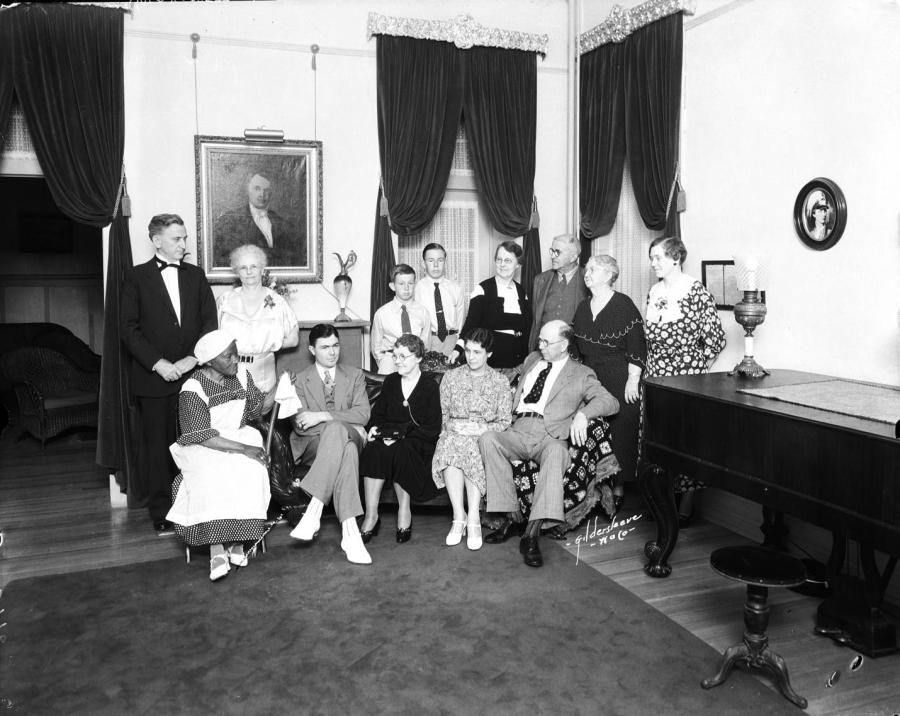
Freeman remained in Waco to attend commencement.[4] According to news coverage of the event, she was “accorded an unusually cordial reception from the audience that overflowed the capacity of Waco Hall.”[5] Described by one local newspaper as having “cooked for the founder of Baylor after she grew to womanhood and served him in other capacities as long as he lived,” as well as being “happy at this recognition being accorded her former master,” Freeman was presented by Neff and Baylor alumna and donor Mary McCauley Maxwell to those in attendance, who rose to their feet in tribute to her.[6][7] Baylor University-connected articles concerning Freeman’s visit described her as a “faithful old darkey” who had been “a slave on Baylor’s plantation” and noted that Maxwell was attempting to “locate the bill of sale made when [Freeman] was sold to Judge Baylor,” presumably so it could be added to the items collected in the Judge R.E.B. Baylor Memorial Rooms.[8][9][10]
The dedication of the memorial rooms, housed in one of the first buildings constructed following the university’s relocation from Independence to Waco in 1886, served as the culmination of Maxwell’s work in gathering artifacts relating to the judge’s life. Such relics included a number of pieces of furniture and a variety of personal effects.[11] [12] An article in the Baylor student newspaper noted that Ann Freeman had “identified every article in the two rooms . . . as that of Judge Baylor’s,” with Maxwell having made a sworn statement before a notary public, “for protection in later years,” that the collection’s articles were authentic.[13]
Maxwell’s project recreated the parlor and main bedroom in the judge’s former residence, which he had built in the early 1850s amid a grove of live oaks and named Holly Oak.[14][15][16] Baylor’s home had stood in Gay Hill, a small community originally located ten miles west of Independence. Both communities, along with Waco to the north, lay within the Brazos River watershed in Central Texas. The dark red color of the velvet draperies and parlor rug found in the rooms was selected because Freeman had reportedly confirmed it as the color of the drapes in Holly Oak’s rooms. In the years following the memorial rooms’ dedication, a photograph of Freeman was placed in the bedroom.[17][18][19][20][21]
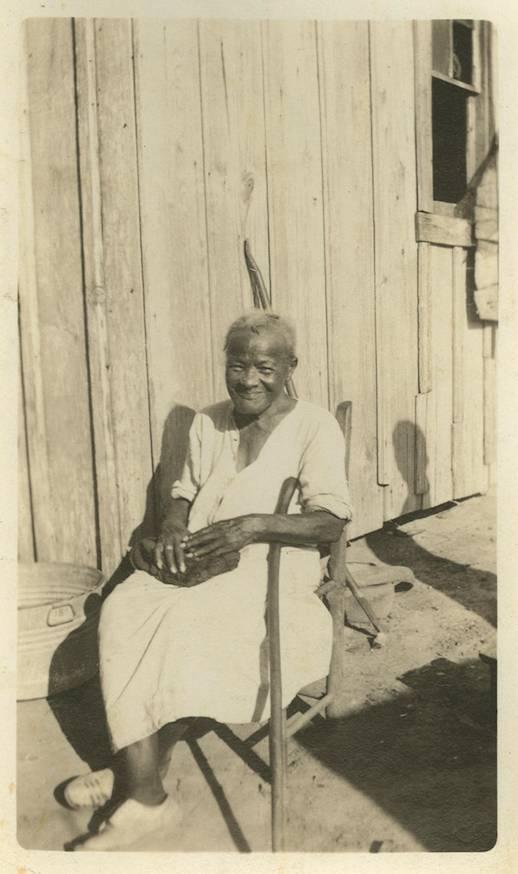
How Maxwell learned of Ann Freeman’s existence is unknown. Their relationship began by at least August 1934, when she visited the elderly woman after attending an event at Independence Baptist Church. A black-and-white photograph of Freeman sitting outside her presumed home near Independence had likely been taken during that trip to Washington County.[22] [23] [24]
• • •
“Two sons are still living, and she lives with one,” the Waco News-Tribune reported on May 25, 1935, after presenting Freeman’s full name as “Ann Graves Baylor Harnsby Freeman,” suggesting to readers that Harnsby and Freeman were the surnames of men she had married and possibly those of her sons as well. However, the newspaper left those matters a mystery.
Other gaps, as well as discrepancies with the historical record, exist in Freeman’s story. In 1935, Freeman said that Henry Lee Graves (1813-1881),[26][27] Baylor University’s first president, had transported her parents, a younger brother and her from Georgia to Texas in 1844. This statement would have struck many of her listeners as likely being inaccurate, considering the university didn’t exist until February 1845 and thus wouldn’t have recruited Graves to serve as its president until that date. Those more deeply schooled in the university’s history also would have known that Graves did not set foot in Independence, Texas, until 1847.[28][29][30] In addition, Freeman’s assertion that she had been sold to Baylor in 1847 runs counter to the history of tax records related to the judge, who went from being taxed for owning four slaves in 1846 in Fayette County, where he initially resided after moving to Texas, to being taxed for owning two slaves from 1849 to 1852 in Washington County, where he established his home in around 1847.[31][32][33][34][35][36]
Research has revealed the names of Freeman’s sons to have been Henry Hornsby (1860-1947)[37][38] and George Hairston (1864-1949).[39] Freeman additionally had a daughter named Alice Hornsby, who was born about 1862 and died in 1922.[40] [41] This research has allowed for the amendment of Freeman’s reported history, which had been primarily derived from her own words, based on corrections from the historical record.
A series of records stretching from Georgia to Texas documents the sequence of ownership experienced by those whom the Graves family enslaved. The first two records pertain to the estate of Thomas Slade Graves (1775-1847),[42] [43] Henry Lee Graves’s father, who moved with his wife, Mary, and most of his adult children from North Carolina to Georgia in the late 1830s, settling in the town of Social Circle, Walton County.[44] When Graves died in March 1847, only a few months after his son Henry’s departure for Texas, the nineteen individuals he owned were identified by first name, age, and occasionally relationship to one another. Appearing in the middle of this list was a child named Ann, whose mother was identified as “Chaney.”[45][46]
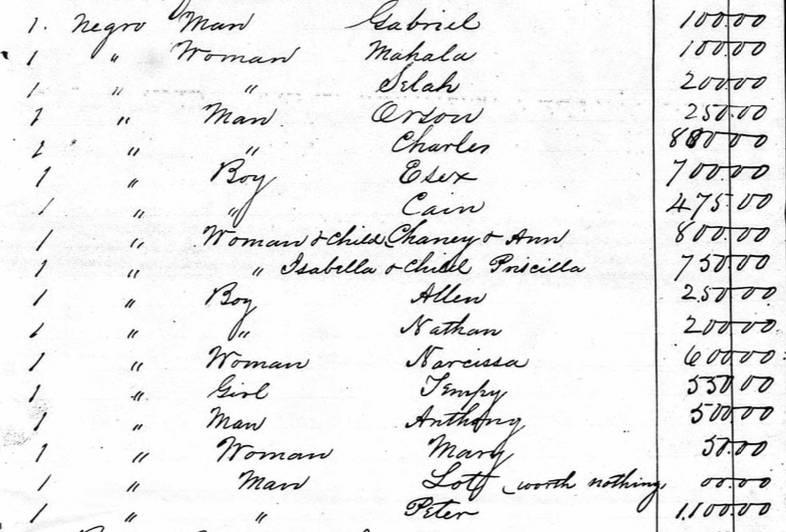
Two years earlier, in making his Last Will and Testament, Graves had named and identified the relationships of his then sixteen slaves, including Chaney.[49] Ann’s absence from this February 1845 will, combined with her appearance in the appraisal of Graves’s estate in July 1847, indicates that she was likely born sometime in late 1845 or early 1846—a timeframe that generally corresponds to Ann Freeman’s account of having been born in 1842 in Georgia and enslaved by a member of the Graves family.
A third document represents the trials of separation that enslaved persons commonly experienced following the probate of their owners’ estates.
Having left most of his assets to his wife, Thomas Slade Graves had further directed that, upon her death, his property should be equally divided among their surviving children.[50] The family’s oldest sons were John Herndon Graves (1807-1889)[51] [52] and George Washington Graves (1811-1877),[53][54] who served as the executor of his father’s estate and was a physician.[55][56] Baylor President Henry Lee Graves came next, and another son, Thomas Augustus Graves (1821-1861),[57][58] was eight years younger. The Graves siblings also included four sisters who had similarly been born in Caswell County, North Carolina, and had moved with the rest of the family to Social Circle, Georgia. None of them, however, lived long enough to personally inherit assets from their father’s estate.[59]
When officials undertaking the 1850 U.S. Federal Census enumerated the population of enslaved people in Walton County, Georgia, four months after Thomas Slade Graves’s wife had died, his estate was documented as owning 22 individuals who ranged in age from three months to 95 years.[60] And when George Washington Graves left Georgia for Independence, Texas, a few years later, following in his brother Henry’s footsteps, he brought several of these enslaved persons with him as property.
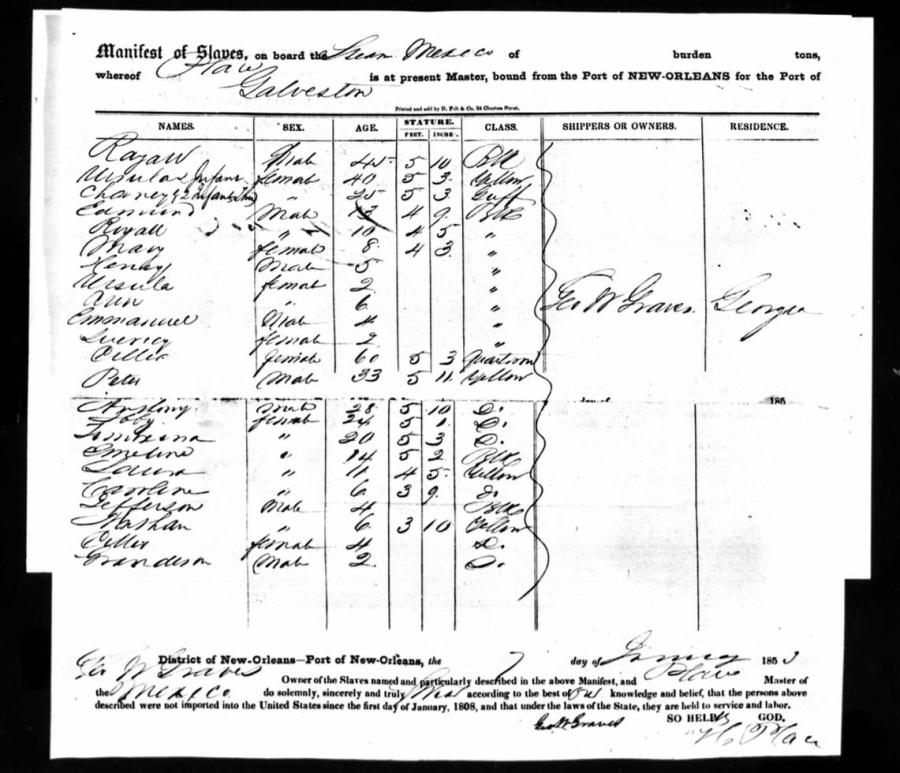
Among the 26 slaves that George Washington Graves had transported from New Orleans to Galveston in January 1853 were five whose names match those of individuals who had appeared in documents pertaining to the people Thomas Slade Graves had enslaved. They included a 25-year-old woman identified as “Chaney” (possibly “Charney”) with two unnamed infants and a six-year-old girl named Ann.[62] Collectively, the four Graves brothers brought at least 36 enslaved people from Georgia to Washington County, Texas, in the 1850s, and they owned a total of 52 bondsmen in the region in 1860.[63] [64] [65][66]
Rather than being owned by Henry Lee Graves, the antebellum historical record indicates that Ann Freeman, her mother, Chaney, and at least two siblings had been the property of George Washington Graves. In the decades after the U.S. Civil War, federal census records for Washington County document that Ann—using a surname variously spelled as “Moorrs,”[67] “More,”[68] “Mose,”[69] and “Moose”[70]—and Chaney, who took her husband Aaron C. Crenshaw Sr.’s surname,[71][72][73] resided near one another near Independence.
Another self-reported link between Ann Freeman and the Graves family, complementing the public story of her enslavement, came when she married a man identified as “Rial Freeman” on April 19, 1885, in Washington County.[74] Rather than using the surname of her final enslaver, Judge R.E.B. Baylor, she declared herself to be “Annie Graves.”[75][76][77] (Rev. James McBride, pastor of Mt. Rose Missionary Baptist Church, one of the first Black congregations in Brenham, Texas, joined Ann and Rial in marriage. Ann’s husband was likely the same person as the ten-year-old boy identified as “Royall” on George Washington Graves’s 1853 slave manifest.) The death certificates of two of her children would also identify her using this name.[78][79]
Following her marriage, “Ann Freeman” was the name she most often used herself, or that was most frequently associated with her, until her death in 1944.[80][81][82][83][84][85] For example, this was the name that her father, Hal J. Graves (abt. 1815-), whose presumed enslavement by the Graves family began in North Carolina,[86][87][88][89] and his last wife, Millie, used in 1894 when deeding Freeman 50 acres of their land along Clay Creek near Independence, noting that the gift was in “consideration of the love and affection we have for our daughter Ann Freeman.”[90] George Hairston, moreover, identified his mother as “Ann Freeman” on her death certificate.[91]
An important element in the reported story of Ann Freeman’s relationship with the Graves family centers on her memory of Baylor President Henry Lee Graves’s selling her to Judge R.E.B. Baylor to satisfy what wasdescribed during her second visit to Waco, in 1939, as “an old debt”—a phrase presumably based on Freeman’s account of the matter.[92][93][94] While no bill of sale involving enslaved persons has been found in Washington County archives in connection to Judge Baylor, a few do exist for George Washington Graves. In February 1857, he sold a man named Elijah for $1,100.[95] And in May 1857, he put up two of his slaves, Anthony and Nathan, as security for a promissory note that would soon come due.[96] Anthony and Nathan’s approximate birth dates—1824 and 1846, respectively—closely match those of two persons by the same names whom Graves had transported to Texas in 1853. Moreover, Nathan’s age roughly corresponds to that of the boy named Nathan who had been identified as Ibby’s child in Thomas Slade Graves’s 1845 will.
A cluster of evidence, rooted both in primary sources and reported information, establishes a reliable timeline for Ann Freeman’s becoming enslaved by Judge R.E.B. Baylor in about 1856, when she was approximately nine years old. This evidence begins with George Washington Graves’s bringing Freeman to Independence in 1853 and includes his willingness to sell his human property, at times in connection to debts. Freeman’s memory of residing in Independence for three years before becoming the judge’s property to satisfy an “old debt,” in turn, corresponds to the number of enslaved persons for which he paid taxes rising from four in 1855 to 13 in 1856.[97][98]
• • •
In the winter of 1939, a few years following her first public appearance at Baylor University, Ann Freeman again traveled to Waco in the company of Baylor supporters. The occasion for the second trip was a ceremony to kick off the university’s Founders Day observance, held every February 1 to celebrate the anniversary of Baylor’s charter. At the event’s conclusion, a monument to Judge R.E.B. Baylor was to be unveiled. Described in The Daily Lariat as an “aged Negro slave of Judge Baylor”—and later, in the student yearbook, as “‘Mammy,’ slave of Judge R.E.B. Baylor”—Freeman arrived in Waco two days before the ceremony.[99] [100][101]
Freeman continued to be valued as a living connection to the judge’s life and a physical affirmation of his legacy as a central figure in both Texas and Baylor University history. Mary McCauley Maxwell reprised her role as Freeman’s means of transportation from her home near Independence to Waco.[102]
Now in her early 90s, Freeman brought a Bible reportedly given to her by Judge R.E.B. Baylor in 1863.[103][104] Upon arriving in Waco, she placed this family treasure in the care of Pat Neff, who had continued to serve as Baylor’s president, for the duration of her visit to the Baylor campus.[105] The morning after the monument’s dedication, Neff announced during the university’s regular chapel service that Freeman had decided to give the Bible to Baylor. “The aged negress was glad to give the treasured book to the university in exchange for a new Bible,” Neff told those in attendance.[106]
The Founders Day program began inside Waco Hall—Baylor’s largest on-campus auditorium at the time—at ten o’clock in the morning on Wednesday, February 1, with Neff serving as master of ceremonies.[107][108] More than 100 guests crowded the auditorium’s stage, bordered by the flags of the United States and Texas. Baylor’s official seal stood in front of the rostrum.[109] Among the estimated crowd of 3,000 were far-flung descendants of the extended Baylor family.[110][111] After an opening hymn and invocation, a scripture reading, and the singing of “Lest We Forget” by the Baylor Mixed Ensemble, Neff presented Ann Freeman to the audience. He welcomed the elderly woman to the stage and shared her story—presumably based on Freeman’s own account of her and her enslavers’ interlinked history—in the following words:
When the first president of Baylor University came from Georgia nearly one hundred years ago to see whether or not he would accept the presidency, he decided he would. It was necessary for him to return to Georgia in order to move out his household effects. He did not have the money to make this trip. Judge Baylor lent him the money to go back to Georgia and move out his family. President Graves brought back with him a negro man and his wife, and a two-year-old negro baby. He sold these people to Judge Baylor as slaves in settlement of the debt created by the borrowing of this money. That two-year-old negro baby is now approximately ninety-six years of age. This morning she honors this occasion with her presence, and I am happy, indeed happy, to present this faithful slave who lived with Judge Baylor from two years of age until the day of his death; and she says that Judge Baylor was a great man and that he always worked for the uplifting of humanity. I want to present this fine character to you at this time for your greetings.[112]
Over the subsequent response by the audience, Neff said, “She can’t see you, but she can hear your applause.” [113][114]
Upon the conclusion of the ceremony inside Waco Hall, participants moved outside for the unveiling of the Judge R.E.B. Baylor monument on the opposite side of Speight Avenue, in an area that would come to be known as Founders Mall. Photographs taken during the program indicate that Ann Freeman participated in the unveiling from a seated location in front of Waco Hall, on the sidewalk at the base of its wide flight of stone stairs.[115][116]
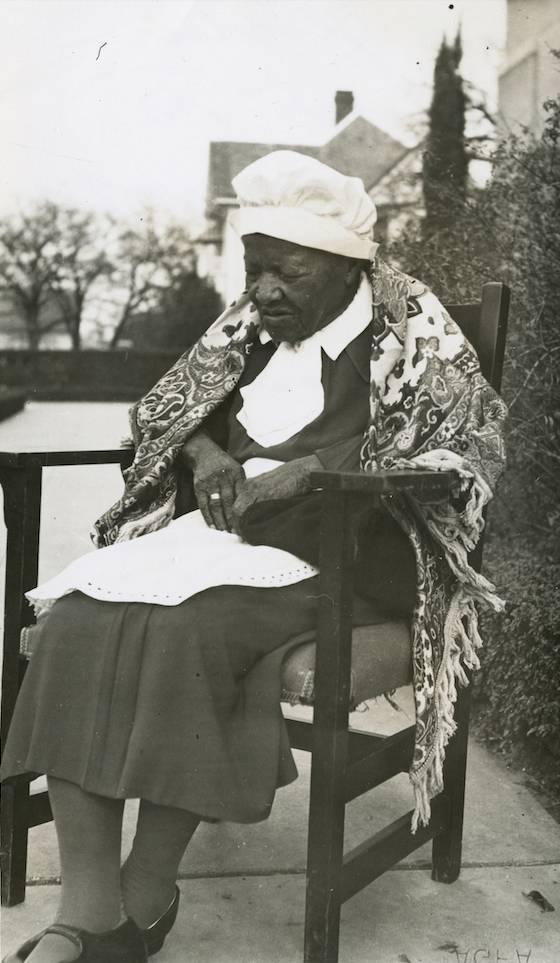
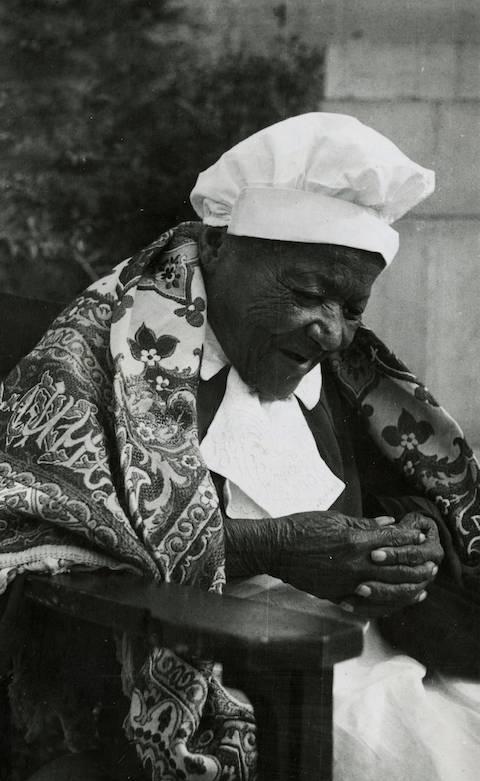
Around noon, family member J. Gordon Baylor pulled a cord that released the large white drapes covering the monument. The band played “Bells Across the Meadows” as two nearby bells chimed, one of them from Baylor’s original campus in Independence. Four students who were descendants of former Baylor presidents then placed a wreath on the statue. The program concluded with a benediction by the president of the University of Mary Hardin-Baylor, an institution also rooted in Baylor’s Independence campus, and a group singing of “That Good Old Baylor Line,” the university’s school song.[119][120][121]
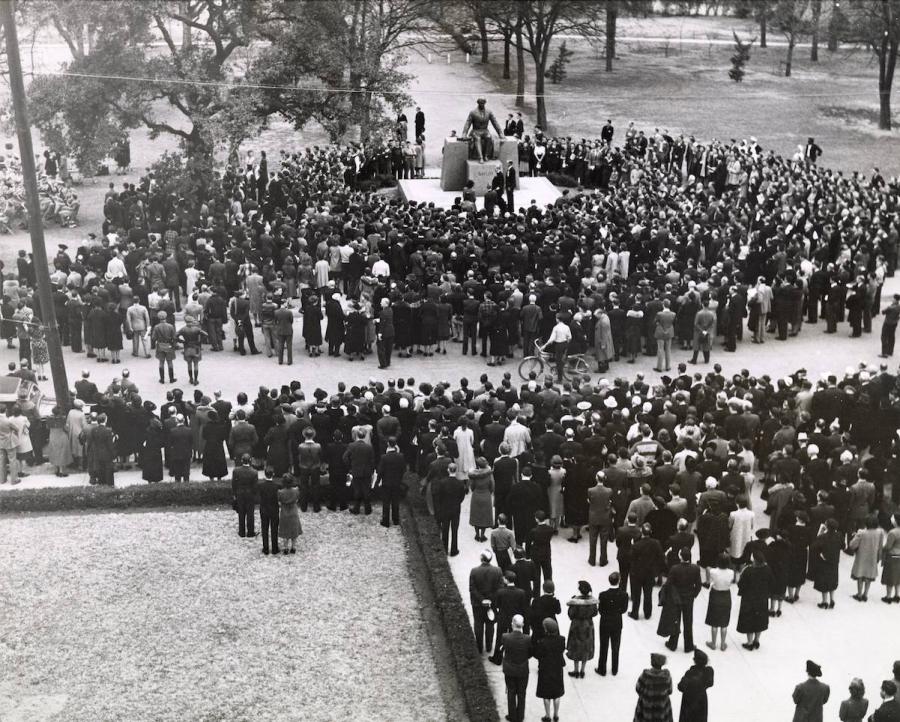
No record of Ann Freeman returning to Baylor University after 1939 has been found, nor has any evidence surfaced that Mary McCauley Maxwell maintained her relationship with Freeman in the years following the Judge R.E.B. Baylor monument’s dedication. In fact, Freeman’s name did not appear in print again until Friday, December 1, 1944, when readers of the Brenham Banner-Press encountered a notable headline on the front page amid columns of war-related news: “Slave of Judge Baylor Dies At Age of 103 Years.” Ann Freeman had died, at four o’clock in the morning on November 28—just a few weeks from reaching what would likely have been, based records from her childhood in Georgia, her 98th birthday. Describing her as a “negress who spent her early life serving as a slave in the household of Judge R. E. B. Baylor, founder of Baylor University,” the newspaper reported that she had passed away at her home near Independence and that funeral services were scheduled for 11:30 a.m. on Sunday at her home. “Born in Georgia, she came to Texas in early life and spent her days in this historic part of Texas. Out of nine children, she is survived by two, Henry and George,” the article concluded. No other notice of Freeman’s death appeared in area newspapers or in Baylor publications. She was laid to rest in what is today known as Liberty Community Cemetery, near Independence, where several of her immediate and extended family members also are buried.[123][124][125]
As Randolph B. Campbell writes of enslaved people in An Empire for Slavery: The Peculiar Institution in Texas, 1821-1865, “Their instinctive will to live was threatened by the harshness and hopelessness of bondage, but at the same time it was encouraged by several institutions that mitigated the psychological conditions of servitude.” As Ann Freeman’s own words and the evidence surrounding her long life testify, such supportive institutions and communities—of family and of faith—played central roles in helping her and those closest to her seek out the fullness of their human potential, both during their enslavement and in the challenging decades that followed emancipation.
Endnotes
[1] “Baylor University Confers Approximately 400 Degrees at Ninetieth Commencement,” Baptist Standard, June 6, 1935, p. 16, https://digitalcollections-baylor.quartexcollections.com/Documents/Detail/baptist-standard-volume-xlvii-number-23-dallas-texas-june-6-1935/1737142?item=1737158.
[2] “Judge Baylor’s Slave Attends Ceremony,” The Daily Lariat, May 27, 1935, p. 1, https://digitalcollections-baylor.quartexcollections.com/Documents/Detail/the-daily-lariat-waco-texas-vol.-37-no.-127-monday-may-27-1935/81962.
[3] Fred Gildersleeve, untitled photograph with handwritten information in red ink on back, May 25, 1935, original print, General Photo Files, accession no. 3976, series no. 1, box no. 92, “Baylor – Memorials – Judge R.E.B. Baylor Memorial Rooms (11),” The Texas Collection, Baylor University, Waco, Texas.
[4] “Baylor Concludes Successful Year; Degrees for 400,” Waco News-Tribune, May 28, 1935, p. 1, 10. Newspapers.com.
[5] “Baylor University Confers Approximately 400 Degrees at Ninetieth Commencement,” Baptist Standard, June 6, 1935, p. 16, https://digitalcollections-baylor.quartexcollections.com/Documents/Detail/baptist-standard-volume-xlvii-number-23-dallas-texas-june-6-1935/1737142?item=1737158.
[6] “Baylor Campus Is Busy Scene,” Waco Times-Herald, May 24, 1935, p. 16. Newspapers.com.
[7] “Baylor’s 90th Year Comes to Glorious End,” Waco Times-Herald, May 27, 1935, p. 1, 3. Newspapers.com.
[8] “Judge Baylor’s Slave Attends Ceremony,” The Daily Lariat, May 27, 1935, p. 1, https://digitalcollections-baylor.quartexcollections.com/Documents/Detail/the-daily-lariat-waco-texas-vol.-37-no.-127-monday-may-27-1935/81962.
[9] “Baylor’s Texas Collection,” The Baylor Bulletin 44, no. 4 (December 1940): 12-17.
[10] Regarding terminology connected to the institution of chattel slavery in the United States, this article generally follows the National Park Service’s recommendations as found on the website for the Frederick Douglass National Historic Site, aside from preserving the original language in quoted materials. Accordingly, the term “enslaver” is used instead of “master.” However, in a manner similar to Mark Auslander’s practice in The Accidental Slaveowner, both “slave” and “enslaved person” are employed as terms to describe those held in bondage although they are not used as equivalent alternatives. The term “slave” is reserved for passages in which the institution of slavery is represented from the perspective of financial or legal matters or from the perspective of those participating in chattel slavery as slaveholders. Otherwise, out of recognition of their personhood and humanity, the term “enslaved person” is used when portraying the experience and agency of individuals whose lives were circumscribed by the bonds of slavery.
[11] “Baylor Cherishes Memory of Early University Donor,” Waco Tribune-Herald, May 26, 1935, p. 1, 7. Newspapers.com.
[12] “Judge Baylor Statue Dedication and History, 1851 June 29, 1936 June - 1939, undated (1 of 3),” Pat M. Neff collection, accession no. 463, sub-series no. 3, subject files, 1845, 1932-1948, box no. 105, folder no. 10, The Texas Collection, Baylor University, Waco, Texas.
[13] “Baylor Memorial Suite Is Interesting Display,” The Daily Lariat, November 1, 1935, 1-2, https://digitalcollections-baylor.quartexcollections.com/Documents/Detail/the-daily-lariat-waco-texas-vol.-38-no.-28-friday-november-1-1935/82257.
[14] Laura Simmons, Out of Our Past: Texas History Stories (Texian Press, 1967), 1.
[15] “Texas, County Tax Rolls, 1837-1910,” digital image, Washington County, 1851, “Baylor R.E.B.,” State Archives, Austin, Texas. FamilySearch.org.
[16] Thomas William Crumpton II, “The Oaks of Independence: A Landscape History of the Original Site of Baylor University and the Potential Surrounding Historic District” (master’s thesis, Baylor University, 2011), 174. As Crumpton documents, R.E.B. Baylor spelled the name of his home in a variety of manners in his correspondence, but “Holly Oak” was the most common spelling.
[17] “University Dedicates Baylor Memorial Room,” The Daily Lariat, May 27, 1935, p. 5, https://digitalcollections-baylor.quartexcollections.com/Documents/Detail/the-daily-lariat-waco-texas-vol.-37-no.-127-monday-may-27-1935/81962.
[18] “Baylor Memorial Suite Is Interesting Display,” The Daily Lariat, November 1, 1935, 1-2, https://digitalcollections-baylor.quartexcollections.com/Documents/Detail/the-daily-lariat-waco-texas-vol.-38-no.-28-friday-november-1-1935/82257.
[19] “Relics in Baylor Room Depict Life of University’s Father,” The Daily Lariat, November 26, 1935, p. 1, https://digitalcollections-baylor.quartexcollections.com/Documents/Detail/the-daily-lariat-waco-texas-vol.-38-no.-42-tuesday-november-26-1935/82425.
[20] “Judge Baylor Statue Dedication and History, 1851 June 29, 1936 June - 1939, undated (1 of 3),” Pat M. Neff collection, accession no. 463, sub-series no. 3, subject files, 1845, 1932-1948, box no. 105, folder no. 10, The Texas Collection, Baylor University, Waco, Texas.
[21] “Baylor’s Texas Collection,” The Baylor Bulletin 44, no. 4 (December 1940): 12-17.
[22] “Ann Graves Baylor Freeman” photographic print mounted on cardboard with handwritten information in black ink on front and back, January 20, 1935, original print, General Photo Files, accession no. 3976, series no. 3, box no. 140, “Baylor – Freeman, Ann Graves Hornby,” The Texas Collection, Baylor University, Waco, Texas.
[23] “[Portrait of Anne Freeman Graves],” undated photograph with handwritten text on back reading “Anne Freeman / Graves / (Baylor slave) / Independence / Tex,” digital image, Robert Emmett Bledsoe Baylor Papers, Star of the Republic Museum, Washington-on-the-Brazos, Washington County, Texas, The Portal to Texas History, https://texashistory.unt.edu/ark:/67531/metapth30607/.
[24] “Judge Baylor Statue Dedication and History, 1851 June 29, 1936 June - 1939, undated (1 of 3),” Pat M. Neff collection, accession no. 463, sub-series no. 3, subject files, 1845, 1932-1948, box no. 105, folder no. 10, The Texas Collection, Baylor University, Waco, Texas.
[25] “[Portrait of Anne Freeman Graves],” undated photograph with handwritten text on back reading “Anne Freeman / Graves / (Baylor slave) / Independence / Tex,” digital image, Robert Emmett Bledsoe Baylor Papers, Star of the Republic Museum, Washington-on-the-Brazos, Washington County, Texas, The Portal to Texas History, https://texashistory.unt.edu/ark:/67531/metapth30607/.
[26] “Sermon: Funeral: Henry Lee Graves, 1881,” Henry Lee Graves Papers, accession no. 1271, series no. 3, literary productions, box no. 1, folder no. 3, The Texas Collection, Baylor University, Waco, Texas.
[27] “Henry Lee Graves” (1813-1881), memorial 46514432, Prairie Lea Cemetery, Brenham, Washington County, Texas, FindaGrave.com.
[28] Lois Smith Murray, Baylor at Independence (Baylor UP, 1972), 74.
[29] “Mrs. Russell at Independence, June 8, 1952,” citing Baylor Historical Society Records, accession no. BU28, series no. 4, literary productions, 1883-1971, box no. 4, folder no. 15, The Texas Collection, Baylor University, Waco, Texas.
[30] “Henry Lee Graves,” About Baylor, undated, https://about.web.baylor.edu/person/henry-lee-graves.
[31] “Texas, County Tax Rolls, 1837-1910,” digital image, Fayette County, 1846, “Baylor R.E.B.,” reel no. 1, 1837-1843, 1845-1877, State Archives, Austin, Texas. FamilySearch.org.
[32] “Texas, County Tax Rolls, 1837-1910,” digital image, Washington County, 1849, “Baylor Robt E.B.,” State Archives, Austin, Texas. FamilySearch.org.
[33] “Texas, County Tax Rolls, 1837-1910,” digital image, Washington County, 1850, “Baylor Robt E.B.” State Archives, Austin, Texas. FamilySearch.org.
[34] Eugene W. Baker, To Light the Ways of Time: An Illustrated History of Baylor University, 1845-1986 (Baylor University, 1987), 175, 180.
[35] “Texas, County Tax Rolls, 1837-1910,” digital image, Washington County, 1851, “Baylor R.E.B.,” State Archives, Austin, Texas. FamilySearch.org.
[36] “Texas, County Tax Rolls, 1837-1910,” digital image, Washington County, 1852, “Baylor Robert E.B.” State Archives, Austin, Texas. FamilySearch.org.
[37] 1900 United States Census, digital image, Washington County, Texas, population schedule, precinct 5, enumeration district (ED) 111, p. 4 (penned), dwelling 59, family 59, line 47, “Henry Hornsby,” Ancestry.com.
[38] “Texas, Death Certificates, 1903-1982,” digital image, “Henry Hornsby,” March 31, 1947, Brenham, Washington County, certificate no. 81918, Ancestry.com.
[39] “Texas, Death Certificates, 1903-1982,” digital image, “George Hairston,” May 30, 1949, Brenham, Washington County, certificate no. 25299, Ancestry.com.
[40] 1880 United States Census, digital image, Washington County, Texas, population schedule, Independence precinct, enumeration district (ED) 151, p. 262C (stamped), p. 27 (penned), dwelling 219, family 231, line 24, “Alice Cockrill,” Ancestry.com.
[41] “Texas Deaths, 1890-1976,” digital image, “Alice Hamilton,” December 25, 1922, Temple, Bell County, certificate no. 33161, FamilySearch.org.
[42] “Sermon: Funeral: Henry Lee Graves, 1881,” Henry Lee Graves Papers, accession no. 1271, series no. 3, literary productions, box no. 1, folder no. 3, The Texas Collection, Baylor University, Waco, Texas.
[43] “Thomas Slade Graves” (1775-1847), memorial 79978485, burial details unknown, death in Walton County, Georgia, FindaGrave.com.
[44] Louise Graves, “Colonel Thomas Graves,” in The Heritage of Caswell County, North Carolina, ed. Jeannine D. Whitlow (Caswell County Historical Association, 1985), 237-38.
[45] “Georgia, U.S., Wills and Probate Records, 1742-1992,” Walton County, Estate Papers, 1820-1900, Gaither, Eli-Graves, Thomas, “Thomas Graves,” 1845-1855, images 989-1066 of 1066, FHL project Georgia 14700, roll 15. Ancestry.com.
[46] “Georgia, U.S., Wills and Probate Records, 1742-1992,” Walton County, Probate Records, Vol. E-F, 1839-1847, Book F, 1843-1847, “Thomas Graves,” 1845-1855, images 613-614, 638-642 of 652, FHL project Georgia 14700. FamilySearch.org.
[47] “Georgia, U.S., Wills and Probate Records, 1742-1992,” Walton County, Probate Records, Vol. E-F, 1839-1847, Book F, 1843-1847, “Thomas Graves,” 1845-1855, images 613-614, 638-642 of 652, FHL project Georgia 14700. FamilySearch.org.
[48] “Georgia, U.S., Wills and Probate Records, 1742-1992,” Walton County, Estate Papers, 1820-1900, Gaither, Eli-Graves, Thomas, “Thomas Graves,” 1845-1855, images 989-1066 of 1066, FHL project Georgia 14700, roll 15. Ancestry.com.
[49] “Georgia, U.S., Wills and Probate Records, 1742-1992,” Walton County, Estate Papers, 1820-1900, Gaither, Eli-Graves, Thomas, “Thomas Graves,” 1845-1855, images 989-1066 of 1066, FHL project Georgia 14700, roll 15. Ancestry.com.
[50] “Georgia, U.S., Wills and Probate Records, 1742-1992,” Walton County, Estate Papers, 1820-1900, Gaither, Eli-Graves, Thomas, “Thomas Graves,” 1845-1855, images 989-1066 of 1066, FHL project Georgia 14700, roll 15. Ancestry.com.
[51] “Sermon: Funeral: Henry Lee Graves, 1881,” Henry Lee Graves Papers, accession no. 1271, series no. 3, literary productions, box no. 1, folder no. 3, The Texas Collection, Baylor University, Waco, Texas.
[52] “John Herndon Graves” (1807-1889), memorial 13548769, Lilac Cemetery, Sharp, Milam County, Texas, FindaGrave.com.
[53] “Sermon: Funeral: Henry Lee Graves, 1881,” Henry Lee Graves Papers, accession no. 1271, series no. 3, literary productions, box no. 1, folder no. 3, The Texas Collection, Baylor University, Waco, Texas.
[54] “Dr. George Washington Graves” (1811-1877), memorial 91700146, Oakland Cemetery, Navasota, Grimes County, Texas, FindaGrave.com.
[55] “Georgia, U.S., Wills and Probate Records, 1742-1992,” Walton County, Estate Papers, 1820-1900, Gaither, Eli-Graves, Thomas, “Thomas Graves,” 1845-1855, images 989-1066 of 1066, FHL project Georgia 14700, roll 15. Ancestry.com.
[56] “Notice . . . ,” The Daily Constitutionalist and Republic (Augusta, Georgia), July 14, 1847, p. 3. Newspapers.com.
[57] “Sermon: Funeral: Henry Lee Graves, 1881,” Henry Lee Graves Papers, accession no. 1271, series no. 3, literary productions, box no. 1, folder no. 3, The Texas Collection, Baylor University, Waco, Texas.
[58] “Thomas Augustus Graves” (1821-1861), memorial 131633018, Old Independence Cemetery, Independence, Washington County, Texas, FindaGrave.com.
[59] “Georgia, U.S., Wills and Probate Records, 1742-1992,” Walton County, Estate Papers, 1820-1900, Gaither, Eli-Graves, Thomas, “Thomas Graves,” 1845-1855, images 989-1066 of 1066, FHL project Georgia 14700, roll 15. Ancestry.com.
[60] 1850 United States Census, digital image, Walton County, Georgia, slave schedule, p. 17 (penned), lines 1-22, “Estate Thomas Graves dec’d,” Ancestry.com.
[61] “New Orleans, Louisiana, U.S., Slave Manifests, 1807-1860,” digital image, “George W. Graves,” January 7, 1853, departure, Ancestry.com.
[62] “New Orleans, Louisiana, U.S., Slave Manifests, 1807-1860,” digital image, “George W. Graves,” January 7, 1853, departure, Ancestry.com.
[63] 1860 United States Census, digital image, Milam County, Texas, slave schedule, Western District, p. 13 (penned), p. 154 (stamped), lines 25-29, “John H. Graves,” Ancestry.com.
[64] 1860 United States Census, digital image, Washington County, Texas, slave schedule, Independence, pp. 12-13 (penned), lines 24-40, 1-8, “Geo. W. Graves,” Ancestry.com.
[65] 1860 United States Census, digital image, Freestone County, Texas, slave schedule, Fairfield, pp. 1-2 (penned), lines 32-39, 1-2, “H. L. Graves,, Ancestry.com.
[66] 1860 United States Census, digital image, Washington County, Texas, slave schedule, Independence, p. 16 (penned), lines 23-35, “Thomas Graves,” Ancestry.com.
[67]1870 United States Census, digital image, digital image, Washington County, Texas, population schedule, subdivision B, no. 3, p. 208 (penned), dwelling 1676, family 1676, line 39, “Ann Moorrs,” Ancestry.com.
[68]1870 United States Census, digital image, Washington County, Texas, population schedule, subdivision B, no. 3, p. 122 (penned), dwelling 1052, family 1052, line 40, “Amy More,” Ancestry.com.
[69]1880 United States Census, digital image, digital image, Washington County, Texas, population schedule, Independence precinct, enumeration district (ED) 151, p. 262C (stamped), p. 27 (penned), dwelling 215, family 227, line 9, “Ann Mose,” Ancestry.com.
[70] 1880 United States Census, digital image, digital image, Washington County, Texas, agriculture schedule, p. 18 (penned), line 2, “Ann Moose,” Ancestry.com.
[71] 1870 U.S. census, Washington County, Texas, population schedule, subdivision B, no. 3, p. 119 (penned), p. 246 (stamped) dwelling 1026, family 1026, lines 20-32, “A. C. Crinshaw” family; digital image, Ancestry (http://www.ancestry.com : accessed November 17, 2022).
[72] 1880 U.S. census, Washington County, Texas, population schedule, Independence precinct, enumeration district (ED) 151, p. 34B (penned), dwelling 283, family 296, lines 10-17, “Chaney Crenshaw” family; digital image, Ancestry (http://www.ancestry.com : accessed November 17, 2022); citing NARA microfilm publication T9, roll 1332.
[73]“Texas, Death Certificates, 1903-1982,” digital image, “Aaron Crenshaw Jr.,” March 3, 1926, Independence, Washington County, certificate no. 12305, Ancestry.com.
[74] Rev. James McBride, pastor of Mt. Rose Missionary Baptist Church, one of the first Black congregations in Brenham, joined Ann and Rial in marriage. Ann’s husband was likely the same person as the ten-year-old boy identified as “Royall” on George Washington Graves’s 1853 slave manifest.
[75] “Texas, Select County Marriage Records, 1837-2015,” digital image, marriage of “Rial Freeman” and “Annie Graves,” April 18, 1885, Washington County, certificate no. 1890, Ancestry.com.
[76] “Texas, Select County Marriage Records, 1837-2015,” digital image, marriage of “Rial Freeman” and “Annie Graves,” April 18, 1885, Washington County, certificate no. 1890, Ancestry.com.
[77] “Marriage Licenses,” Brenham Banner-Press (Texas), April 23, 1885, p. 3, The Portal to Texas History.
[78] “Texas Deaths, 1890-1976,” database with images, FamilySearch (https://familysearch.org : accessed November 10, 2020), certificate image, “Alice Hamilton,” December 25, 1922, Temple, Bell County; citing certificate no. 33161, Texas Department of State Health Services, Austin, TX.
[79] “Texas, Death Certificates, 1903-1982,” digital image, “George Hairston,” May 30, 1949, Brenham, Washington County, certificate no. 25299, Ancestry.com.
[80] “Real Estate Transfers,” Brenham Banner-Press (Brenham, Texas), June 14, 1894, p. 3. The Portal to Texas History.
[81] “Jury Docket,” Brenham Banner-Press (Texas), March 8, 1898, p. 3. The Portal to Texas History.
[82] 1900 U.S. census, Washington County, Texas, population schedule, precinct 5, enumeration district (ED) 111, p. 4B (penned), dwelling 62, family 62, line 56, “Real Freeman”; digital image, Ancestry (http://www.ancestry.com : accessed October 13, 2020); citing NARA microfilm publication T623, FHL microfilm 1241677.
[83] 1910 U.S. census, Washington County, Texas, population schedule, precinct 5, enumeration district (ED) 108, p. 10B (penned), dwelling 190, family 191, line 80, “Reil Freeman”; digital image, Ancestry (http://www.ancestry.com : accessed October 13, 2020); citing NARA microfilm publication T624, roll 1599, FHL microfilm 1375612.
[84] 1930 U.S. census, Washington County, Texas, population schedule, Precinct 5, enumeration district (ED) 239-16, p. 9B (penned), dwelling 185, family 195, line 75, “Onina Freeman”; database with images, Ancestry (http://www.ancestry.com : accessed November 10, 2020); citing NARA microfilm publication T626, FHL microfilm 2342140.
[85] “Slave of Judge Baylor Dies at Age of 103 Years,” Brenham Banner-Press (Brenham, Texas), December 1, 1944, p. 1, The Portal to Texas History.
[86] “Texas, Deaths and Burials, 1903-1973,” digital image, “Ann Freeman,” November 28, 1944, Brenham, Washington County, certificate no. 2047, FamilySearch.org.
[87] 1870 United States Census, digital image, Washington County, Texas, population schedule, subdivision B, no. 3, p. 122 (penned), dwelling 1050, family 1050, line 32, “H. Greaves,” Ancestry.com.
[88] 1870 United States Census, digital image, Washington County, Texas, population schedule, subdivision B, no. 3, p. 208 (penned), dwelling 1676, family 1676, line 34, “H.J. Graves,” Ancestry.com.
[89] 1880 United States Census, digital image, digital image, Washington County, Texas, population schedule, Independence precinct, enumeration district (ED) 151, p. 262C (stamped), p. 27 (penned), dwelling 214, family 226, line 6, “Hal Graves,” Ancestry.com.
[90] Deed between grantors “Hal Graves” and “Millie Graves” and grantee “Ann Freeman,” digital image, May 2, 1894, pp. 152-53, vol. 37, County Clerk’s Office, Washington County, Texas.
[91] “Texas, Deaths and Burials, 1903-1973,” database with images, FamilySearch (https://familysearch.org : accessed October 20, 2020), certificate image, “Ann Freeman,” November 28, 1944, Brenham, Washington County; citing certificate no. 2047, State Registrar Office, Austin, TX, FHL GS microfilm 1769412.
[92] “Aged Negress Will Honor Former ‘Massa,’” The Daily Lariat, February 1, 1939, p. 3, https://digitalcollections-baylor.quartexcollections.com/Documents/Detail/the-daily-lariat-waco-texas-vol.-41-no.-65-wednesday-february-1-1939/86510?item=86524.
[93] “Unveil Baylor Statue Today,” Fort Worth Star-Telegram (Fort Worth, Texas), February 1, 1939, p. 1. Newspapers.com.
[94] “Judge Baylor Statue Dedication and History, 1851 June 29, 1936 June - 1939, undated (1 of 3),” Pat M. Neff collection, accession no. 463, sub-series no. 3, subject files, 1845, 1932-1948, box no. 105, folder no. 10, The Texas Collection, Baylor University, Waco, Texas.
[95] Bill of sale between grantor “Geo W. Graves” and grantee “Wm H. Payne,” February 28, 1857, record no. 181, p. 249, vol. P, County Clerk’s Office, Washington County, Texas.
[96] Deed of trust between grantor “George W. Graves” and grantee “A. P. Morgan,” digital image, May 22, 1857, record no. 294, pp. 390-92, vol. P, County Clerk’s Office, Washington County, Texas.
[97] “Texas, County Tax Rolls, 1837-1910,” digital image, Washington County, 1855, “Baylor Hon. R.E.B.,” State Archives, Austin, Texas. FamilySearch.org.
[98] “Texas, County Tax Rolls, 1837-1910,” digital image, Washington County, 1856, “Baylor R.E.B.,” State Archives, Austin, Texas. FamilySearch.org.
[99] “Baylor Monument Is Witness of Celebration,” The Daily Lariat, February 2, 1939, p. 1, https://digitalcollections-baylor.quartexcollections.com/documents/mirador/86517.
[100] “Cactus and Crutches,” The Round-Up (Baylor University, 1939), 45.
[101] “Ex-Slave Will Join Honor to Old Massa,” Waco Times-Herald, January 31, 1939, p. 1, 8. Newspapers.com.
[102] “Ex-Slave Will Join Honor to Old Massa,” Waco Times-Herald, January 31, 1939, p. 1, 8. Newspapers.com.
[103] “Aged Former Slave of Judge Baylor to Have Part in Local Event,” The Waco News-Tribune, Feb. 1, 1939, p. 10. Newspapers.com.
[104] “Aged Negress Will Honor Former ‘Massa,’” The Daily Lariat, February 1, 1939, p. 3, https://digitalcollections-baylor.quartexcollections.com/Documents/Detail/the-daily-lariat-waco-texas-vol.-41-no.-65-wednesday-february-1-1939/86510?item=86524.
[105] “Aged Negress Will Honor Former ‘Massa,’” The Daily Lariat, February 1, 1939, p. 3, https://digitalcollections-baylor.quartexcollections.com/Documents/Detail/the-daily-lariat-waco-texas-vol.-41-no.-65-wednesday-february-1-1939/86510?item=86524.
[106] “Baylor Family Honor Guests,” Waco Times-Herald, February 2, 1939, p. 1, 3, Newspapers.com.
[107] “‘Baylor Day’ List/Materials, 1936, 1939, undated (1 of 2,” Pat M. Neff collection, accession no. 463, sub-series no. 3, subject files, 1845, 1932-1948, box no. 103, folder no. 1, The Texas Collection, Baylor University, Waco, Texas.
[108] “Founder’s Day, 1939,” Pat M. Neff collection, accession no. 463, sub-series no. 3, subject files, 1845, 1932-1948, box no. 112, folder no. 3, The Texas Collection, Baylor University, Waco, Texas.
[109] “Judge Baylor Statue Dedication and History, 1851 June 29, 1936 June - 1939, undated (1 of 3),” Pat M. Neff collection, accession no. 463, sub-series no. 3, subject files, 1845, 1932-1948, box no. 105, folder no. 10, The Texas Collection, Baylor University, Waco, Texas.
[110] “Baylor’s Founder Paid Tributes As Statue Dedicated,” The Waco News-Tribune, Feb. 2, 1939, p. 1, Newspapers.com.
[111] “Baylor’s Founder Paid Tributes As Statue Dedicated,” The Waco News-Tribune, Feb. 2, 1939, p. 1, Newspapers.com.
[112] “Judge Baylor Statue Dedication and History, 1851 June 29, 1936 June - 1939, undated (1 of 3),” Pat M. Neff collection, accession no. 463, sub-series no. 3, subject files, 1845, 1932-1948, box no. 105, folder no. 10, The Texas Collection, Baylor University, Waco, Texas.
[113] “Founder’s Day, 1939,” Pat M. Neff collection, accession no. 463, sub-series no. 3, subject files, 1845, 1932-1948, box no. 112, folder no. 3, The Texas Collection, Baylor University, Waco, Texas.
[114] “Baylor’s Founder Paid Tributes As Statue Dedicated,” The Waco News-Tribune, Feb. 2, 1939, p. 1, Newspapers.com.
[115] “Judge Baylor Slave,” photographic print with handwritten text in pencil on back, February 1, 1939, General Photo Files, accession no. 3976, series no. 3, box no. 140, “Baylor - Freeman, Ann Graves Hornsby (2),” The Texas Collection, Baylor University, Waco, Texas.
[116] “Ann, Servant of Judge Baylor . . . ,” photographic print with handwritten text in black ink and pencil on back, February 1, 1939, General Photo Files, accession no. 3976, series no. 3, box no. 140, “Baylor - Freeman, Ann Graves Hornsby,” The Texas Collection, Baylor University, Waco, Texas.
[117] “Judge Baylor Slave,” photographic print with handwritten text in pencil on back, February 1, 1939, General Photo Files, accession no. 3976, series no. 3, box no. 140, “Baylor - Freeman, Ann Graves Hornsby (2),” The Texas Collection, Baylor University, Waco, Texas.
[118] “Judge Baylor Slave,” photographic print with handwritten text in pencil on back, February 1, 1939, General Photo Files, accession no. 3976, series no. 3, box no. 140, “Baylor - Freeman, Ann Graves Hornsby (2),” The Texas Collection, Baylor University, Waco, Texas.
[119] “‘Baylor Day’ List/Materials, 1936, 1939, undated (1 of 2,” Pat M. Neff collection, accession no. 463, sub-series no. 3, subject files, 1845, 1932-1948, box no. 103, folder no. 1, The Texas Collection, Baylor University, Waco, Texas.
[120] “Judge Baylor Statue Dedication and History, 1851 June 29, 1936 June - 1939, undated (1 of 3),” Pat M. Neff collection, accession no. 463, sub-series no. 3, subject files, 1845, 1932-1948, box no. 105, folder no. 10, The Texas Collection, Baylor University, Waco, Texas.
[121] “Thousands at Baylor See Statue Unveiled,” Fort Worth Star-Telegram, February 2, 1939, p. 1. Newspapers.com.
[122] Untitled photographic print with handwritten text in pencil on back, February 1, 1939, General Photo Files, accession no. 3976, series no. 1, box no. 91, “Baylor – Memorials – R.E.B. Baylor Statue Dedication,” The Texas Collection, Baylor University, Waco, Texas.
[123] “Slave of Judge Baylor Dies at Age of 103 Years,” Brenham Banner-Press (Brenham, Texas), December 1, 1944, p. 1. The Portal to Texas History.
[124] “Texas, Deaths and Burials, 1903-1973,” digital image, “Ann Freeman,” November 28, 1944, Brenham, Washington County, certificate no. 2047, FamilySearch.org.
[125] “Ann Femon,” memorial 237519726, Liberty Community Cemetery, Independence, Washington County, Texas, FindaGrave.com.